



"S.H.Figuarts (SHINKOCCHOU SEIHOU) ULTRAMAN TIGA MULTI TYPE" Roundtable Discussion
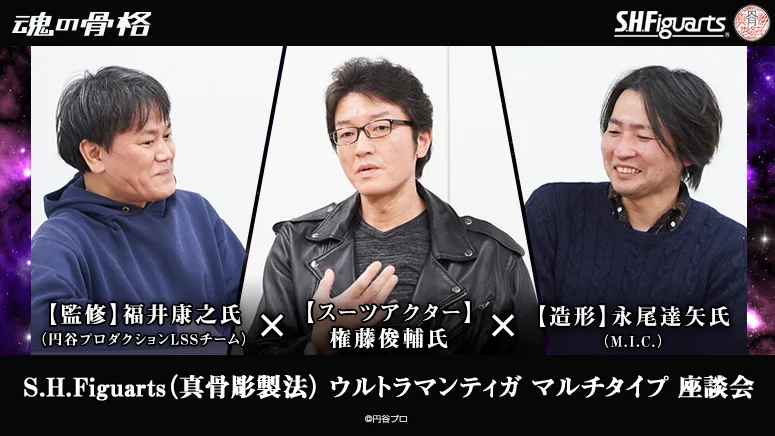
Finally, "S.H.Figuarts (SHINKOCCHOU SEIHOU) ULTRAMAN TIGA MULTI TYPE" will be released.
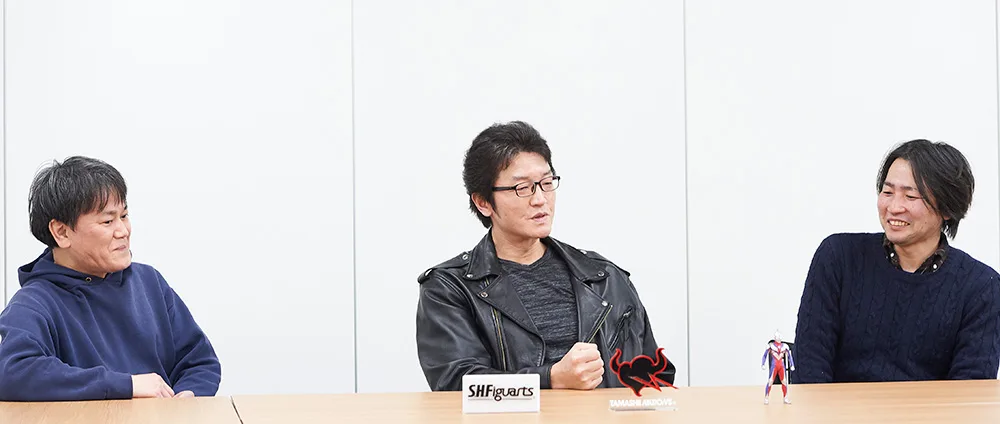
There, Mr. Shunsuke Gondo, who is known as a suit actor of "Ultima Tiga", Mr. Tsuburaya Productions who was involved in costume and character maintenance in the Heisei Ultra series trilogy starting from Tiga, Mr. Tatsuya Nagao who is in charge of this modeling A roundtable discussion was held by the three parties.
For "S.H.Figuarts (SHINKOCCHOU SEIHOU) ULTRAMAN TIGA MULTI TYPE," Jo Narita, who was in charge of suit modeling at the time, created the prototype of the statue. Mr. Nagao of M.I.C., who has worked on numerous "S.H.Figuarts" models, created the movable parts, and Mr. Fukui, who was familiar with the suits of the time, supervised the development. We asked the three people who played a central role in the development to talk about "Ultraman Tiga".
S.H.Figuarts (SHINKOCCHOU SEIHOU) ULTRAMAN TIGA MULTI TYPE
--First of all, please tell us about "S.H.Figuarts (SHINKOCCHOU SEIHOU) ULTRAMAN TIGA MULTI TYPE".
Gondo: I think the production staff did a really great job. When I look at my hands, I think, "Ah, these are my hands." The impression of the fingertips, created by the suit actor, really brings out the overall expression.
Nagao: This is actually the first time I've seen it painted. This time, the pants are made of a soft material, so I think the silhouette turned out really nicely. Tiga is Ultraman whose charm lies in his standing pose, so the best thing about him is that you can enjoy displaying him standing up. Since it's an articulated figure, it's probably meant to be poseable a lot, but personally, I want to display him standing up. Also, I'm curious to see how well this soft material will work in the final product.
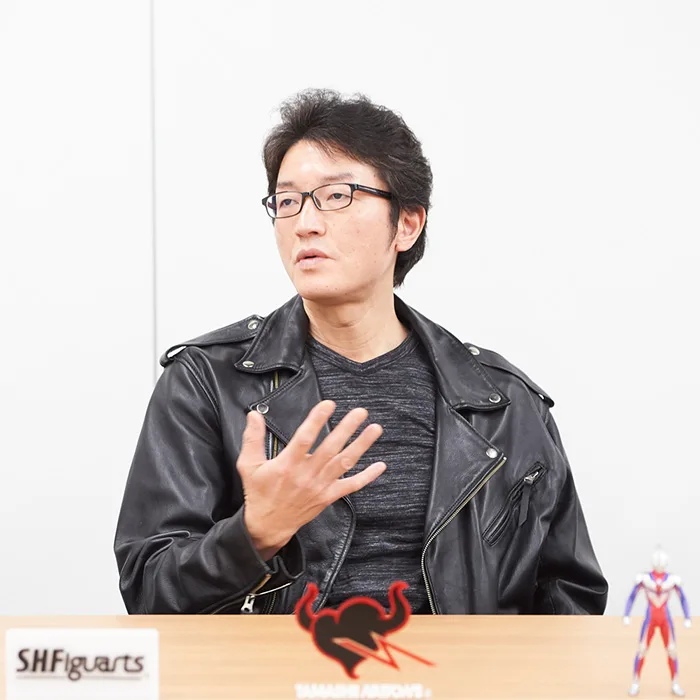
Fukui: Actually, I haven't had a chance to hold it in my hands yet, but it looks really cool. The lines of the paintwork are great too. When I was supervising the creation of this figure, it was very difficult to determine if the overall balance was okay, as if the movable joints had been temporarily removed. I think Mr. Nagao, who sculpted it, probably felt the same way.
NagaoYes. When we added the articulation, we kept creating steps and unevenness, and even though the lines looked fine, when we looked at it as a three-dimensional object, it felt somehow disjointed. Just a slight change in angle would change the silhouette, and I didn't know what to do... It was a constant struggle with that (laughs).
――What did you think frankly when you received an offer to scan Mr. Gondoh directly this time?
GondoIt was like, "I knew it was coming (laughs)." We had talked about it as a joke before, but... However, it's been 25 years since I played Tiga, so things are different now. I struggled with whether there was any point in it. I do keep myself in shape to some extent on a regular basis, but when they ask me to have the same physique as back then... Even so, I feel a responsibility because I, and of course the fans, love Tiga so much. But when I asked them, they said they just wanted me to provide data on my skeletal balance, so I told them not to expect any muscles, but they said that if people still want me to do it this much, then I'd be happy, so I thought this must be my life's work and said, "Okay." However, I did say, "If I'm not convinced, I'll cut you off without hesitation."
――How was the actual scan?
GondoI thought I'd get into some kind of pod, and a laser beam would go around my body and then "snap!" and the picture would be taken in an instant, but contrary to my expectations, they told me I had 5 minutes for each pose. I was like, "Wow, I wasn't told about that..." (laughs). It was pretty tough.
Nagao: The method involved having the subject remain still while a full-body scan was performed. I also needed to understand the fine details and balance during the development process, so I took quite a few photos during the scan.
Gondo: Doing flying poses and standing on one leg was really tough, because if I moved I had to start over! (cries) They were scanning me like they were licking me all over. I was surprised when they asked me to take a picture of the soles of my feet.
Nagao: Well, basically, I just wanted them to not move (laughs). It must be tough, but please be patient, something like that. I felt really sorry about it.
Gondo: In past photo shoots, there have been still shooting sessions (posed shots for press, etc.), but even then, this was the longest shoot I'd ever experienced.
――It was a process of making a movable figure by Mr. Nagao's hand while feeding back the scan data that you had a hard time to the prototype of Mr. Minoru Narita's statue.
Nagao: The task was to add articulation while trying not to disrupt Mr. Narita's sculpting and form as much as possible. Naturally, in order to create clearances and thickness, we sometimes had to make it a little bigger, and the form and lines gradually changed. At that point, we would adjust it again by comparing it with Mr. Gondo's scan data. That's how we did it.
GondoSince it's a posable figure, there seems to be a limit to how much range of motion can be achieved, so I asked them to make the area from the stomach to the back a little thinner, or even make it as thin as possible.
Fukui: We first check the finished product using digital images, but there's always a significant gap between the actual product and the images. Sometimes, things that were a concern in the digital images turn out to be fine in the actual product, and vice versa. That was the biggest thing I learned from supervising this project.
GondoI gave quite a bit of input on the shape of the neck. The way the face looks changes depending on the type of neck the mask sits on. In fact, even if the same mask is worn, the impression of the mask will be different depending on the performer. Ultraman Tiga is an epoch-making Ultraman of the Heisei era, and I gave abstract instructions to make sure that the beautiful design created by Tiga's designer, Hiroshi Maruyama, properly conveys and expresses the unique "sensuality" and "allure" of Ultraman Tiga (laughs).
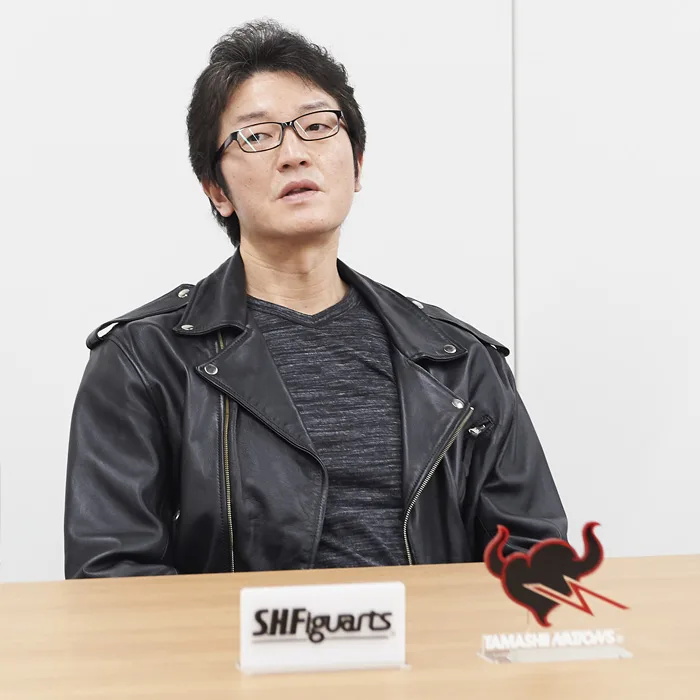
Fukui"Elegance" and "sexiness" are very difficult to capture, aren't they? It's like the beauty of capturing a single moment in movement, something Mr. Gondo mentioned several times during the supervision process. I think it was quite a challenging request to figure out how to express that in an articulated figure. The standing pose was the part we focused on the most. Mr. Gondo said that the Tiga from "Ultraman Tiga THE FINAL ODYSSEY" was the form he considered to be complete. We were careful about this aspect during the supervision process.
FukuiSince Tiga has a long history, starting with the TV series, we discussed which era of Tiga we wanted to portray. Ultimately, we decided that the Tiga from "THE FINAL ODYSSEY" was the best and most complete version.
NagaoI had some doubts along the way, but with feedback from Mr. Gondo and Mr. Fukui, I aimed for the best possible result.
GondoI heard that it took much longer to complete than planned because I kept giving negative feedback during the final stages. For example, I would say things like, "This is how it should tighten up when you train it properly." They really went all out with my meticulous attention to detail.
The first series in the Heisei Ultraman Series, "Ultraman Tiga"
――Please tell us about the design of Ultraman Tiga.
Gondo: I had this ingrained image of Ultraman as being red and silver, so I was surprised to see blue added to that. My first impression was that he looked like a rotating sign in front of a barber shop (laughs). And the moment I saw his face, well, I'd seen it in an illustration, I got the impression that he was a bit like a marine creature. But I thought he was cool.
NagaoI think it's a wonderful design that successfully finds a good balance between the excellent form of the Showa era and the new, modern design of the Heisei era.
FukuiThe first thing I saw was the poster's visual. What really struck me was the silhouette of the head, and the use of color. I was amazed by the unprecedented design.
Nagao: The beauty of the eye shape, which is often mentioned, is both gentle and somehow dignified. That's what I find wonderful and cool about it.
GondoThere are many iconic tokusatsu characters in Japan, but Ultraman is a character whose suit fits the body's outline perfectly, clearly showing the actor's body shape. That's why we suit actors couldn't even wear knee or elbow supports (for Ultraman). We were taught that the suit was "skin" for Ultraman. After all, it's the simple designs that children can draw that are the characters that endure. I think that nowadays there's the pain of creation, the struggle of having to create something different from the previous work every year, so I sympathize with the fact that the designs are being added on, but on the other hand, I feel that the use of many colors, the lines, and the overall details have become too busy.
FukuiYes, nowadays there are many variations appearing, including Form changes, and some of the designs have become quite complex.
Gondo: That's why I feel so lucky to have been given the opportunity to play Tiga, Dyna, and Gaia at such a good time. I was really fortunate that it was my turn to play Ultraman.
――Mr. Gondoh was appointed for the audition, wasn't it?
Gondo: When I was working as a freelance action actor, I was approached with the offer, "We're making Ultraman TV series for the first time in a while, why don't you audition?" I was young at the time and wanted to play a tokusatsu hero. But actually, I wanted to play a Space Sheriff (laughs). After the audition, everyone around me, including Tsuburaya Productions and the director, told me that it was obvious it was me. However, at that point, I was surprised that Nakamura and I would be playing the same character. At that time, I hadn't been told about the three-type change. After learning about the type change, I understood. I think that worked out well.
--Did you have any difficulties at that time as a suit actor?
Gondo: I played Tiga many times after the TV series ended, but I really struggled with the visibility every time. When I was actually fighting a monster, I could only see the tip of its left toe. Quadrupedal monsters were still within my field of vision, but with humanoid and alien types, once they switched places and I turned around, I couldn't even tell where they were anymore. And as for the face, it's something I don't usually think about in my daily life, but I really realized how much oxygen I needed. It was so hard to breathe. There was actually a slit in the mouth area that was just big enough to fit a razor blade, but that wasn't enough to get in enough air. Regardless of the visibility, I always thought that there must be some way to improve the air intake, but that never really worked out... Even so, the Tiga suit was improved upon again and again, and it all came together in The Movie.
――Is there any improvement in ease of movement while being consolidated?
GondoUnfortunately, that's one thing that didn't change (laughs)... Ultimately, one of the most distinctive features of Ultraman suit is that the mask and wetsuit are integrated. When you twist and change direction in the air on a trampoline, you first twist your neck as hard as you can to steer, but that becomes restricted.
Fukui: Because the wetsuit is made of rubber, it gets pulled back. That applies not only to the neck but to other movements as well. I imagine it must have been difficult to act in a way that didn't succumb to that pulling force.
GondoFor example, the peephole doesn't follow when you move your head. And there's a counter-reaction when you try to assume a flying pose.
Fukui: We would stuff the suit and adjust it to hold as much as possible, but it was often difficult to get it right. As we did take after take, we were constantly exhausted. As the person in charge of the costume, I took the utmost care to ensure that no scenes were ruined due to costume malfunctions. I was only involved in episode 49, "The Star of Ultra," of the Tiga TV series, but the initial problems with the suit had been mostly fixed, so I managed to prevent any other problems from occurring. After that, I shifted to "Ultraman Dyna," and I had the opportunity to work with Mr. Gondo for a long period of time after that.
To the fans
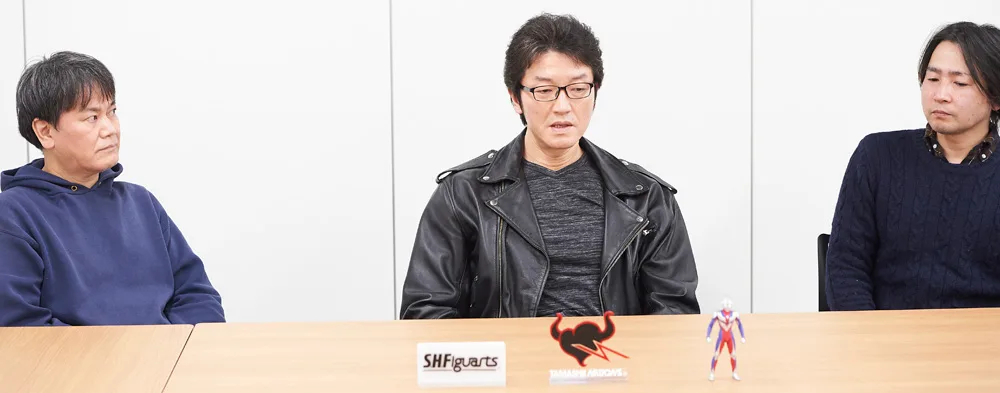
-- So, finally, what is your message to the fans who will be getting "S.H.Figuarts (SHINKOCCHOU SEIHOU) ULTRAMAN TIGA MULTI TYPE"?
GondoIt's like saying, "Sorry to keep you waiting." When I first heard about it, I was like, "Huh?", but this is truly Tiga made with SHINKOCCHOU SEIHOU. It incorporates several new technologies never seen before, and I can confidently say that the finished product will be more than satisfactory. You'll be amazed! I had so much fun with it too!
FukuiI'd like people to see the distinctive form of Tiga, as portrayed by Mr. Gondo.
NagaoI really hope people will have a blast playing with it. I also love playing with products that I've created, so I can't wait to get my hands on it (laughs).
FukuiFirst, I'd like to play around with it by moving it around in various ways, and then display it in a standing pose.
Nagao: I'm the type who, once I've played with them for a while, just wants to display them standing still (laughs). I like to line them up standing still.
Fukui: If Dyna and Gaia are released later, I definitely want to display all three together.
Gondo: I don't want Tiga to wear a cape, though (laughs).
--Thank you everyone.
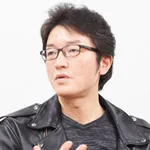
Shunsuke Gondo (Ultraman Tiga /Suit Actor)
Born in 1971.
From the 1996 TV program "Ultraman Tiga" to 2001, he played "Ultraman Tiga" in The Movie and original video works.
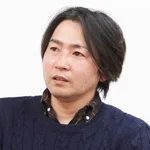
Tatsuya Nagao (MIC)
Joined MIC Co., Ltd. in 2003.
He has been interested in toys since he was a child and started modeling as a hobby.
He studied sculpture at art school and has been involved in many SHFiguarts products since joining the company.
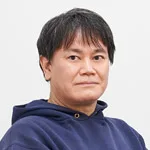
福井康之(円谷プロダクション LSSチームマネージャー)(ふくい やすゆき)
Born in 1968.
Participated in the pilot version of "Ultraman Neos" as modeling and character maintenance.
Since then, he has been involved in Tsuburaya Productions
Currently Tsuburaya Productions representative of the LSS team is the modeling department of Dakushon.
* March 5th (Friday) 15:30: Corrected a typographical error in the text.
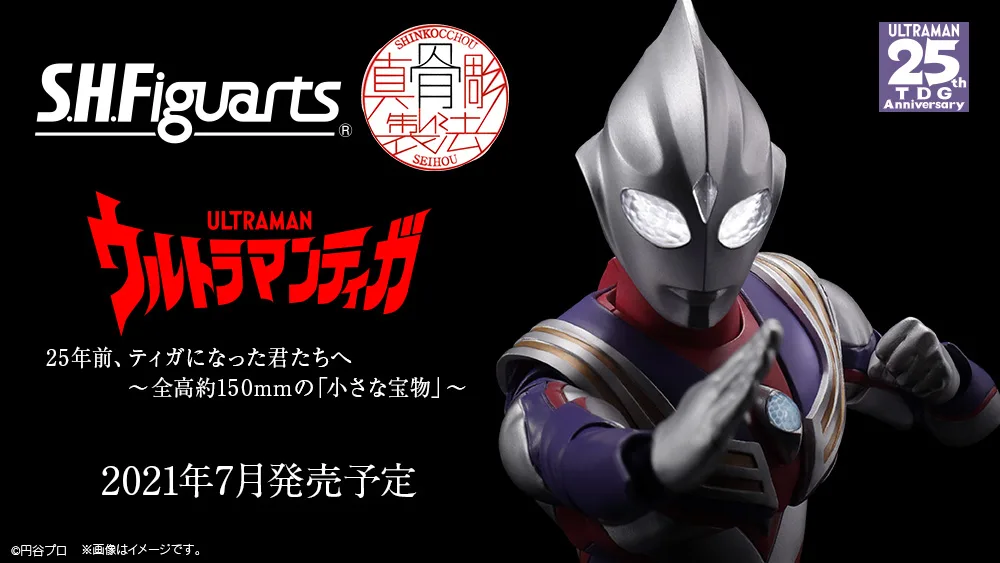


This series uses one of S.H.Figuarts's new ways of manufacturing figures to reproduce the soul of the small-screen heroes as dynamic, 14 cm figures. In the "true bone carving method" (Shinkoccho Seihou), figures are constructed from the inside-out, starting from the skeleton instead of the exterior. This results in more natural movement while preserving the character's personality.
- ©円谷プロ